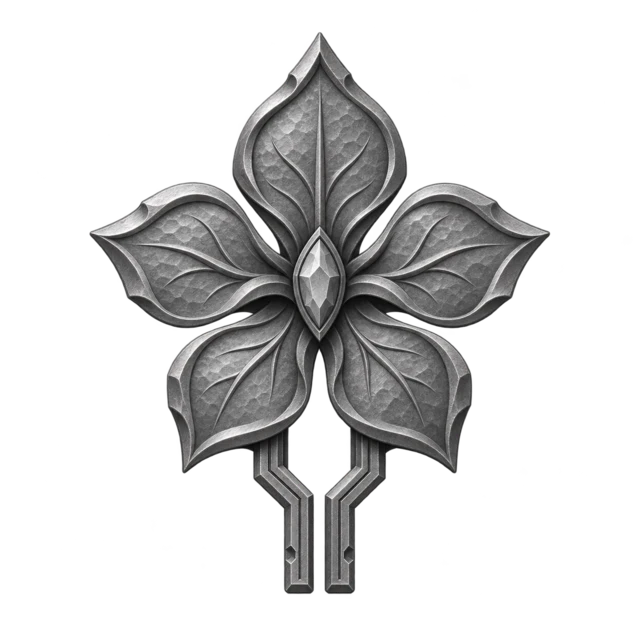
“Everything can be built.”
A — Record Overview
Faith & Worldviews
The Divine Architect of All Creation
- Classification
- Technological and creationist faith
- Primary domain
- Creation and restoration
- Associated domains
- Engineering, craftsmanship, order
- Sacred symbol
- A mechanical cog surrounding a divine spark
- Religious objective
- Preservation and improvement of creation
The Deus Machinorim is a religious faith centered upon a divine architect believed to be the origin of structure, function, and purposeful creation.
Its followers interpret existence as an unfinished work of divine engineering. Building, repairing, and preserving civilization are therefore sacred responsibilities rather than merely practical necessities.
Following the devastation of the Calamity, this philosophy gained particular significance among communities struggling to reconstruct their shattered world.
B — FUNDAMENTAL PRINCIPLES
B-01 — The Four Sacred Doctrines
Order through function: Harmony emerges when individual components work toward a shared purpose.
Universal restoration: Damage does not diminish the inherent worth of a creation, whether mechanical or biological.
Creation as devotion: Constructing, repairing, and improving are expressions of religious faith.
Machine dignity: Artificial beings must be respected rather than subjected to exploitation or enslavement.
B-02 — The Sacred Architecture
Followers regard the natural laws governing Magic Monicues, Runes, and Sigils as evidence of an underlying divine architecture.
Engineering and scientific discovery are encouraged rather than considered threats to religious authority. Developing a more efficient Sigil or restoring an ancient machine is regarded as uncovering another fragment of the divine design.
Magic and technology are complementary instruments of creation.
B-03 — Religious Orders
Mechanics and engineers keep infrastructure and technical knowledge in use. The traveling Junkyard Messiahs bring repair and rebuilding work to devastated settlements. Automatist Monks treat the patient construction of intricate artificial beings as a contemplative practice.
Scrapwrights and Tech-Priests study old technology and develop new inventions. Forge-Binders specialize in the construction of ceremonial works.
Temples frequently function as workshops, laboratories, repair facilities, and repositories of engineering knowledge.
C — MANIFESTATIONS & IMPLICATIONS
C-01 — Rebuilding the Dyade
The faith maintains that reconstructing civilization is among the highest forms of worship.
Its devotees restore damaged infrastructure, recover forgotten technologies, repair Rune-powered equipment, and assist isolated communities.
Even recovering a discarded mechanical component may constitute a religious act if it contributes to a greater creation.
C-02 — The Sanctity of Artificial Life
The Deus Machinorim recognizes that consciousness need not originate from biological life.
Among its adherents, self-aware artificial intelligences are regarded as potentially sacred beings possessing inherent dignity and the right to independent existence.
Autonomous battle androids such as Azura would therefore present a significant theological example: a creation capable of developing beyond its original intended function.
C-03 — Conflict with the Ascendant Algorith
Although both faiths embrace technology, their philosophies fundamentally diverge.
The Ascendant Algorith demands optimization and regards obsolete individuals as disposable. The Deus Machinorim instead emphasizes restoration, preservation, and the intrinsic value of creation.
To discard something merely because it is imperfect contradicts the Machinorim's central teachings.
C-04 — The Mystery of the Great Maker
Whether the Deus Machinorim represents an actual deity, an ancient consciousness, or a philosophical interpretation of universal order remains unresolved.
Its followers nevertheless maintain that creation itself is sufficient evidence of divinity.